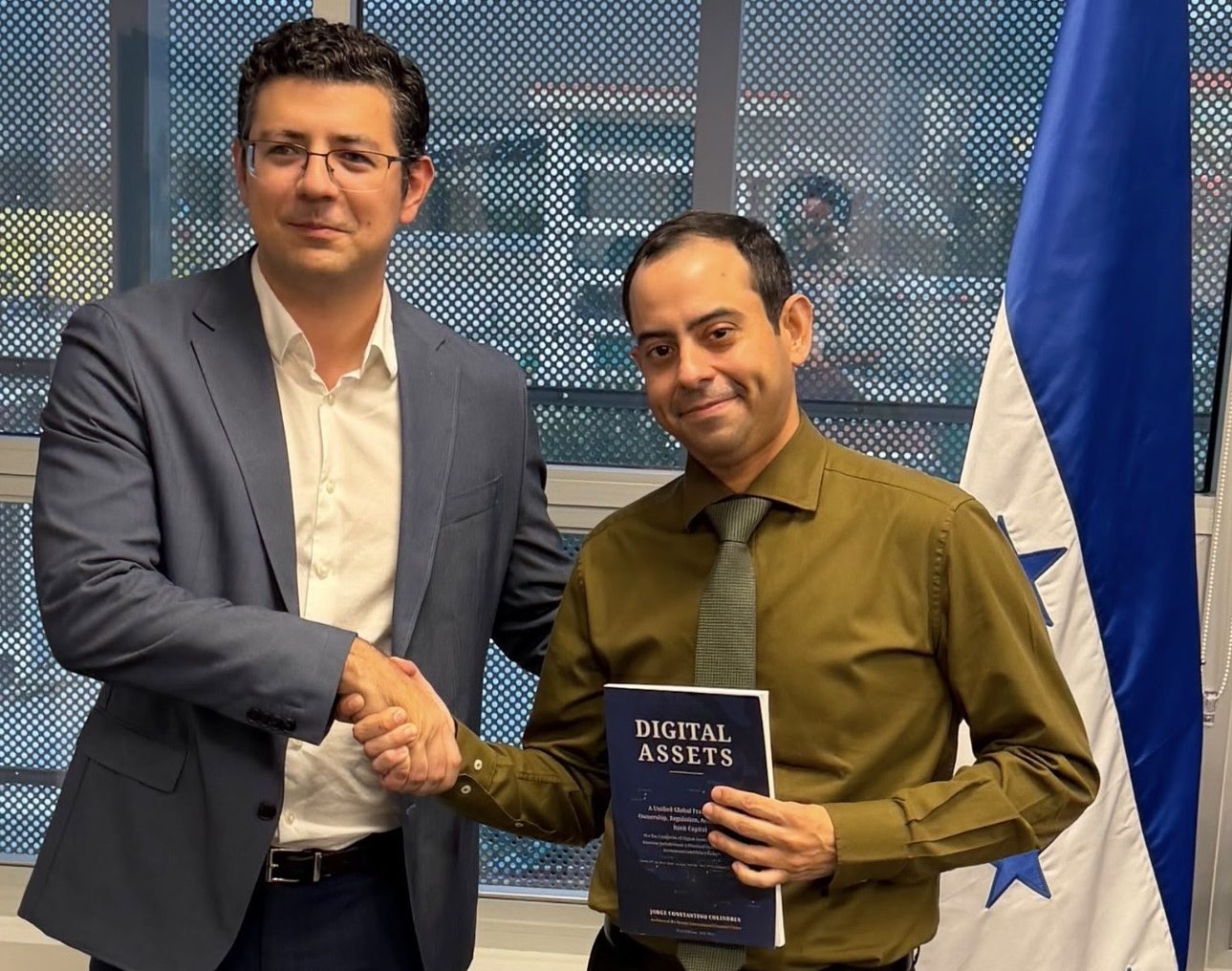
The first copy of a first edition is given once. There is no second first copy, and an author who is honest with himself knows, well before the printer delivers, exactly where it is going.
Mine went this month to Doctor Nicolás J. García Pineda, Commissioner President of the Comisión Nacional de Bancos y Seguros.
I had two reasons. The first is the one anyone would guess.
Honduras is developing a new regulatory framework to integrate digital assets into the national financial system. That is an inflection point, and I do not use the phrase loosely. A country writing this framework for the first time is not choosing a policy. It is choosing an architecture, and architectures are difficult to unbuild once occupied. The question cannot be answered in the abstract, because there is no such thing as the regulatory treatment of digital assets. There is only the treatment of a payment stablecoin, of a tokenised security, of a native protocol token, of a fiscal token, each different from the others in property, in supervision, in the accounts and in the capital charge.
That is the book I wrote, and I wrote it because it did not exist. Its method fits in a sentence: ask what the holder owns, ask which rulebook governs, and the accounting, the capital and the insolvency outcome follow. Ten categories of digital assets in five families, traced through nineteen jurisdictions and the global standard setters, with every operative definition quoted verbatim so that it can be lifted straight into an opinion, an application or a rulebook. FATF Recommendation 15 for the perimeter of the service provider. Basel’s SCO60, in force since January of this year, for the price a bank pays to hold exposure. IFRS and US GAAP for the accounts, which no longer agree with each other. The law stated as at 1 July 2026, across an asset class of roughly USD 2.3 trillion.
I did not write it from a library. I wrote it at a desk in Roatán while designing and deploying the regulatory framework of a financial centre, which is to say I wrote it while needing it. Every question in it is a question I had to answer before a licence could be granted.
So much for the first reason. The second is older, and it is the one I actually want to record here.
In 2017 I bought a book called Los administradores de la sociedad anónima: deberes y responsabilidad civil. Its author was Nicolás J. García Pineda. I bought it out of pure intellectual curiosity.
I read it in two weeks.
In the third week I was asked to advise on the corporate governance of a business group in which the family was handing management to non family professionals and wanted prevention, accountability and control measures properly set in place before doing so.
I have never forgotten the sequence, because I did nothing to deserve it. Had the call come a month earlier I would have taken the engagement with good instincts and only a very basic framework. Instead I arrived at that table having spent a fortnight thinking about precisely the question the client was asking: what a director owes, to whom, and how that duty is made enforceable rather than merely felt. The book was open on my desk throughout. The architecture I built for that group was built on it.
The engagement became a practice: Board Solutions Centroamérica, and through it I spent years advising leading business groups and families in Honduras on professional boards, on strategic planning, on risk management and internal control systems. Everything I know about how an institution is made to answer for itself began in those years, and those years began with a purchase made for no reason at all.
I have thought since about what is owed in a case like that. An author cannot know who he has equipped. He writes into the dark, and the effect is registered only on the reader’s side of the transaction. Which means that the debt is real, entirely one sided, and permanently unenforceable, three characteristics that ought to interest anyone who thinks about obligations for a living.
It cannot be discharged. It can only be acknowledged, and it can only be acknowledged in the currency in which it was incurred.
That is what the first copy was for.
Digital Assets: A Unified Global Framework of Ownership, Regulation, Accounting and Bank Capital (first edition, July 2026, INERTIA Advisory LLC, Roatán; the law stated as at 1 July 2026) is available on Amazon.
Leave a Reply